xxi PREFACE: WHAT ONE NEEDS TO KNOW
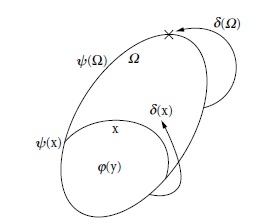
Now, all the standard paradoxes of self-reference are inclosure paradoxes.4 Consider, for example, Russell’s paradox. If x is any set, then the set of all its members which are not members of themselves is a set, and can easily be shown not to be a member of x. Applying this operation to the totality of all sets therefore gives a set that is both in and not in that totality. In this case, Ω is the set of all sets; δ(x) = {y ∈ x : y ∉ y}; and ψ(x) is the vacuous condition, x = x.
Some of the paradoxes in question are paradoxes of definability. A paradigm of these is König’sparadox. Something is definable if there is a (non-indexical) noun-phrase that refers to it. If a is a definable set of definable ordinals, then (since this is countable), there is a least ordinal greater than all the members of a. It is obviously not a member of a, but it is definable by the italicized phrase. Since the set of all definable ordinals is itself definable, we may apply this operator to it to obtain a set that cannot be referred to (defined), but which yet can. In this case, Ω is the set of all definable ordinals; ψ(x) is ‘x is definable’; and δ(x) is the least ordinal greater than all the members of x.
Somuch for some of the nuts and bolts of dialetheism. There is, of course,much more to be said about it. In particular, one might think that the view cannot be right, since it queers the pitch concerning truth, rationality, communication, or some such notion. It does not.5
Let us pass on to another important preliminary matter.This concerns noneism (the view that some objects do not exist).6
Some objects do not exist: fictional characters, such as Sherlock Holmes; failed objects of scientific postulation, such as the mooted planet Vulcan; God (any one
4 See Priest (1995), Part 3.
5 See Priest (2006).
6 What follows in the next two sections is spelled out in much greater detail in Priest (2005).