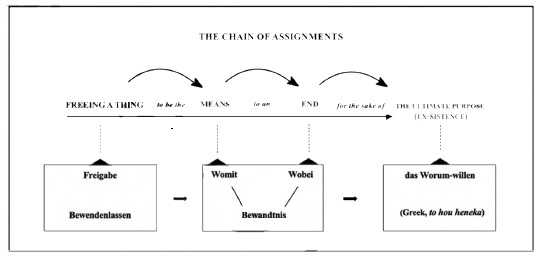
Means-end relations are oriented to a purpose. Thus the stone is a means for pounding in tent pegs; the tent pegs are a means for holding the tent steady; the tent is a means to keep off the rain, and ultimately the whole set of means-end relations is directed to keeping me warm and dry. That whole process is for the sake of a possibility and purpose of mine: spending the night comfortably. o The stone gets its significance from the entire set of means-end relations, and those relations get their significance from the end I have projected, which in turn gets its significance from my ultimate purpose, namely to ex-sist.
Figure 18.1
The whole set of means-end relations, which is directed to ex-sistence as the final purpose (in this case, continuing to ex-sist by staying dry), is prior to and establishes the significance of the stone, the tent pegs, etc. The set of means-end relations is ultimately ordered to my ex-sistence, which is not some thing but is intrinsically “worldly,” involved in the world of meaning. Moreover, ex-sistence is not a means to a further end that lies beyond itself. It is the ultimate purpose of all human activity. My ex-sistence is what I am always concerned about, and all my actions are ultimately for the sake of ex-sisting. o
We will not pursue the matter further at this point. Having established that ex-sistence is the ultimate purpose of all means-end relations, we now take up what it means to free something from the status of just-there-ness so that it can serve as a means to an end.
4. Freeing something to be useful: two senses of the term. o Freeing something to be a means to an end [Bewendenlassen] can be understood as either an ontic act (a posteriori and personal-ex-sistentiel) or an ontological structure (a priori and structural-ex-sistential).